How a pile of pallets became a movement.
We didn't set out to build a company. We set out to stop watching good boxes get destroyed. The rest followed one truckload at a time.
Want to work with us?
Tell us your box challenge — we love the weird ones.
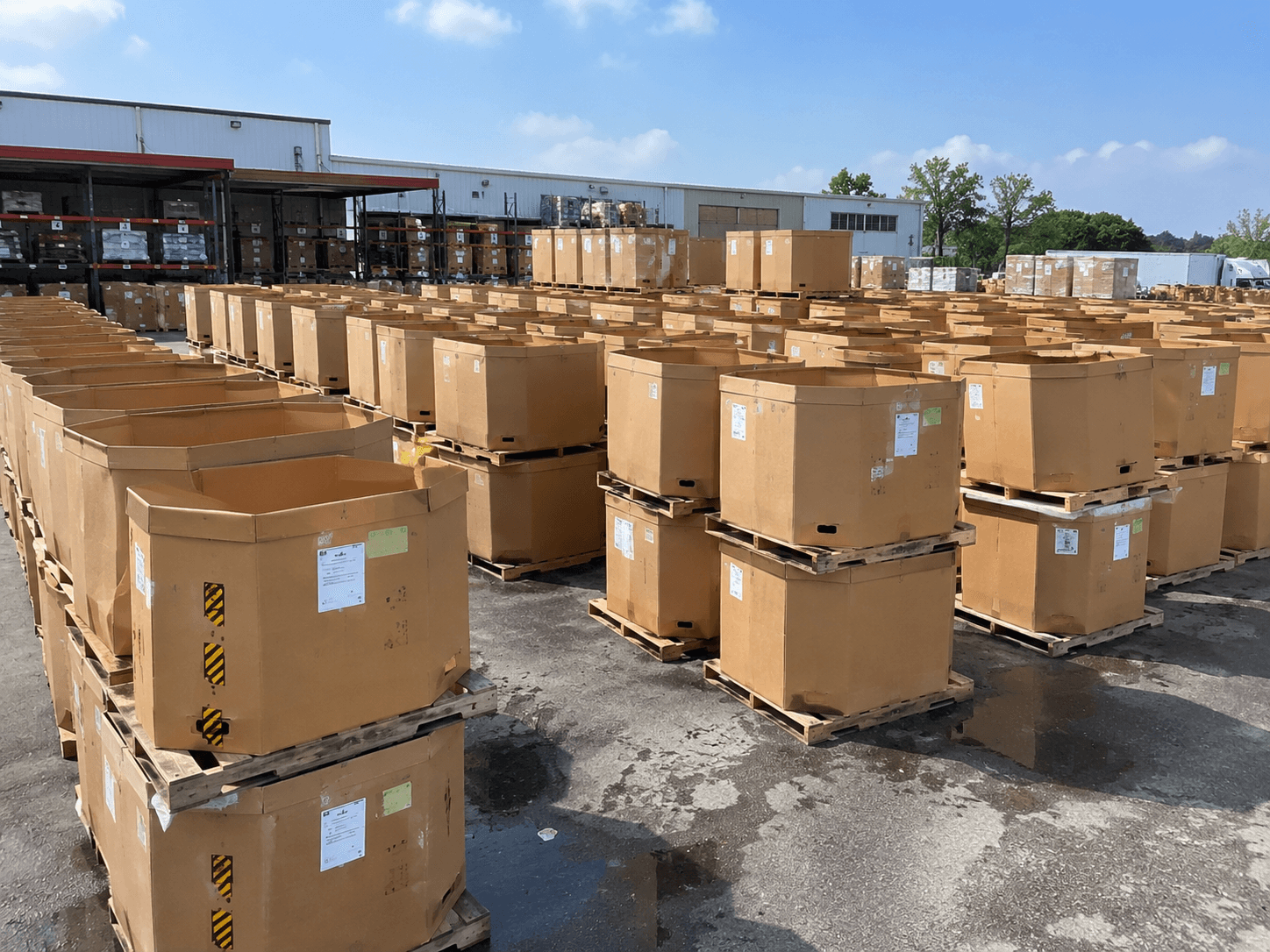
The Woods Cross yard on a restock day — thousands of boxes between their first life and their next.
EcoBoxes Cali is a circular packaging company founded in 2014 and headquartered in Woods Cross, Utah. We buy, sell, recycle and haul used and new Gaylord boxes, bulk containers, pallets and accessories across the lower 48 — and turn boxes too worn to reship into upcycled goods. What began as two people refusing to watch good corrugated get crushed is now a nationwide yard that has rehomed 1.6 million+ boxes and diverted 12,000+ tons of fiber from landfill. Same honest grading, same email-first promise, a whole lot more boxes.
Two people, one baler, and a bad feeling
It started with a sound nobody forgets once they know what it means: the slow crunch of a hydraulic baler folding perfectly good triple-wall Gaylords into a brick. Our founders were standing on a warehouse floor in 2014, there to pick up something else entirely, when they watched a pallet of boxes — square, dry, structurally fine, boxes that had one or two easy trips left in them — get fed to the machine because sending them back cost more than buying new.
That is the quiet math that fills landfills: not villainy, just a missing middleman. Nobody wanted to destroy those boxes. There simply was not a buyer, a grader, a truck and a phone number that made reuse the easy call. So they loaded what they could into a pickup, rented a corner of a lot in Woods Cross, and started making calls to the warehouses down the road: stop crushing them — we'll take them off your hands.
The first customers were skeptical. "You want to pay me for boxes I was about to throw away?" Yes. Because a graded, resold Gaylord is worth real money to the next company down the supply chain — and because keeping it in service beats every recycling program on the planet. Twelve years later that is still the entire business, just with more trucks.
The short version
- Founded: 2014, Woods Cross, Utah
- What we do: buy, sell, recycle & haul Gaylords, bins, pallets & accessories
- Reach: shipping across the lower 48, hub in Utah
- Rehomed: 1.6M+ boxes and counting
- Diverted: 12,000+ tons of corrugated
- Landfilled by us: zero, ever
- How to reach us: email only — hello@ecoboxescali.com
The timeline
A yard grows up — one honest truckload at a time.
One pallet, one idea
Two founders watched a warehouse crush perfectly good Gaylords into a baler. They loaded a pickup instead — and EcoBoxes Cali was born in a rented corner of a Woods Cross lot.
From corner to yard
Word spread that someone would actually buy surplus boxes. We took over the full yard, added grading tables, and started sorting A–D so buyers knew what they were getting.
Closing the loop
We launched buy-back and recycling so customers had one partner for the whole life of a box. Landfill drops to zero for anything that passes through us.
Wheels under it
Our own regional trucks and a backhaul network meant we could move boxes affordably — and stop shipping empty air.
Upcycled goods
Boxes too worn to reship became planters, furniture and dunnage. The third life was official.
A million and counting
Over 1.6 million boxes rehomed and 12,000+ tons of corrugated diverted — with the same honest grading we started with.
What each turning point actually meant
The timeline is the highlight reel. Here is what was really happening behind each date.
Proving reuse was a market, not a favor
The hardest part of year one was not logistics — it was belief. Warehouses assumed a used box was worthless. Every load we bought and resold proved the opposite. By 2016 the corner had become the whole yard, and we built grading tables so a "good" box meant the same thing to us and to the buyer.
Closing the loop with buy-back
Selling boxes was half a solution. Customers still had no honest home for worn-out ones. Launching buy-back and recycling made us the partner for a box's entire life — buy it, use it, sell it back, and bale it to zero landfill only when it is truly spent.
Trucks, and the end of shipping air
Freight was the last thing standing between reuse and virgin on price. Our own regional trucks plus a backhaul network — filling trailers that would otherwise return empty — let us move boxes affordably instead of paying to ship empty air across the country.
The third life, and the million mark
Boxes too crushed to reship stopped being scrap and became planters, furniture and dunnage. By 2026 we crossed 1.6 million boxes rehomed and 12,000+ tons diverted — with the exact same grading discipline we started with in a rented corner.
Twelve years, measured
Rounded down, logged at the yard, and backed by weigh tickets — not marketing.
We keep these numbers deliberately conservative. Every ton of diversion is calculated from real inbound and outbound weights logged at the yard, never modeled or rounded up. See the full methodology on our sustainability page.
How the operation runs, day to day
No mystery. Here is what happens between a box arriving on our dock and leaving for its next life.
Inbound & weigh-in
Trailers back in, we weigh the load, and every box gets eyes on it. Surplus we bought gets logged against the quote we already put in writing — no dock-day surprises for anyone.
Sort & grade
Boxes are separated by footprint and wall count, then graded A–D by a human against a fixed scale for crush, wall integrity, staining and prior use. Each lot is photographed so buyers see the real box.
Stage & match
Graded lots are staged by size and grade. Our logistics coordinator matches outbound orders to backhaul-friendly freight lanes so trucks run full both ways.
Ship, bale, or build
Reusable boxes ship to their next customer. Truly spent corrugated is baled to a mill — zero landfill. Boxes between the two become upcycled goods on the shop bench.
Our grading philosophy
A grade is a promise. If we call a box Grade B, a buyer 1,500 miles away who has never set foot in our yard has to be able to trust that word completely — because they are loading product into it sight unseen. That trust is the entire company, so we protect it obsessively.
We grade against a fixed A–D scale, every box gets a human's eyes, and every lot is photographed before it is listed. We would rather under-grade and delight you than over-grade and win one sale we never see again. When we are unsure between two grades, we call it the lower one. Honest grading is slower and it costs us margin — and it is the reason customers come back for the next truckload.
See exactly what each letter means on the used boxes page.
| Grade | Condition | Best for |
|---|---|---|
| A | Like-new, clean walls, minimal prior use | Retail-facing, export, first reuse |
| B | Sound with light wear or prior tape | Everyday shipping & storage |
| C | Usable, visible wear or staining | Internal moves, scrap & parts bins |
| D | Structurally spent | Upcycling or baling to a mill |
The people who move product
If pallet-sized boxes flow through your building, in either direction, we are built for you.
Manufacturers
Steady graded bulk boxes inbound, and a paid outlet for surplus so packaging stops being a cost center.
Distributors & 3PLs
Consistent supply across sites, backhaul-friendly freight, one partner for buy, sell and recycle.
Farms & growers
Field-ready bins by the truckload in season, then buy-back or recycling when harvest wraps.
Retailers & reverse logistics
Returns containers that arrive graded and close the loop instead of filling a dumpster.
The values that run the yard
Growth never changed the three filters we use to decide what to buy, list, bale or build. They are not a poster in the break room — they are the actual rules.
- Reuse first. The EPA waste hierarchy ranks reuse above recycling. Before we bale anything, we ask whether it can carry one more load. Most can.
- Radical honesty on grades. Real condition, photographed, every time. No stock photos, no surprises on the dock.
- Do the math. Sustainability without numbers is a slogan. Every order can come with conservative, defensible diversion figures.
Read the long version on our mission & values page.
The impact beyond the invoice
Every box we keep in service is a box a mill never has to re-pulp and a tree that keeps standing. Twelve years in, that adds up: 12,000+ tons of fiber that stayed out of the ground, water and energy that re-manufacturing never had to spend, and truckloads that ran full instead of empty.
Closer to home, we are a small Woods Cross employer that pays fair wages for honest work and hires on character. The most sustainable supply chain is also a local one — see the impact you can claim on our sustainability page.
Questions people ask about us
The short, honest answers.
When was EcoBoxes Cali founded, and where are you based?
Why is there no phone number anywhere?
Do you really pay for used boxes?
What happens to boxes too worn to reuse?
Do you only serve Utah or California?
Are your sustainability numbers audited?
More about EcoBoxes Cali
The story is only part of it.
Got boxes to move — or a dock to fill?
Whether you are buying, selling, or recycling, one email starts it all.